Composer/Saxophonist/Technologist extraordinaire Molly Jones and I made an album. It is released by NoRemixes. Here are two video previews of the album as well as the link to the Bandcamp site. All tracks in the album were recorded live.
Enjoy!


Program Notes
This piece is a praise on things and events that are beyond my comprehension and control. Effect of subtle sonic changes on my mind, body, and soul is an example of such things.
Hardware Setup and Instruments
Performance Notes
How to Run the Computer Part
I taught Digital Signal Processing Theory class in the last Spring. I have never studied this hard to teach a course. As a result, I learned (or relearned) about DSP quite a bit. More specifically, I learned to appreciate elegance of “classic” techniques, such as AM, FM, sample-and-hold, and delays. I think I can explain them in digital terms. Most importantly, I learned that digital signal processing is all about (good) math.
The best way to wrap up the semester and summarize what I have learned is to make a piece using the new techniques I have learned.
1. To start the piece, I begin with a sinusoid generated with very slow Low Frequency Oscillator (LFO) on its pitch. The LFO’s shape is made with a wave shaping function using polynomials. The result is an unusual curve pitch pattern.
2. On this polynomial curve, I add sample and hold. The smooth line gets “steps” in terms of pitch. I change the S&H rate to create different rhythms
3. As the piece progresses, I would like to have some frequency modulation gradually fading in.
4. This should sound fun if I have more of them. Here is an example of all the techniques with four sinusoids. The rate of S&H, the shape of polynomial curve, and the modulation rate of FM are randomly selected for each line.
The resulting sound sounded like a good accompaniment for a noisy electronic piece. So I played a no-input mixer and custom synthesizer over the polynomial pads. I also continued the piece with algorithmically drum part that I have developed for Snake and Ox track in my latest album (more about this track later).
Here’s the final result, Snake Extension. I think I’ll add this to my solo repertoire.
Visceral Media Records will be releasing my new album in few weeks. The album is titled 120V, and it is a “best of” album that contains my works composed in the past 10+ years. It also has a new track for no-input mixer and computer (marked with * in the track listing).
The album has quite a variety in terms of electronic music style. I feel very happy to share an album that contains pieces that reflects who I was and who I am. My life and music has changed immensely since I started to make electronic after plugging things into 120V outlets in the US.
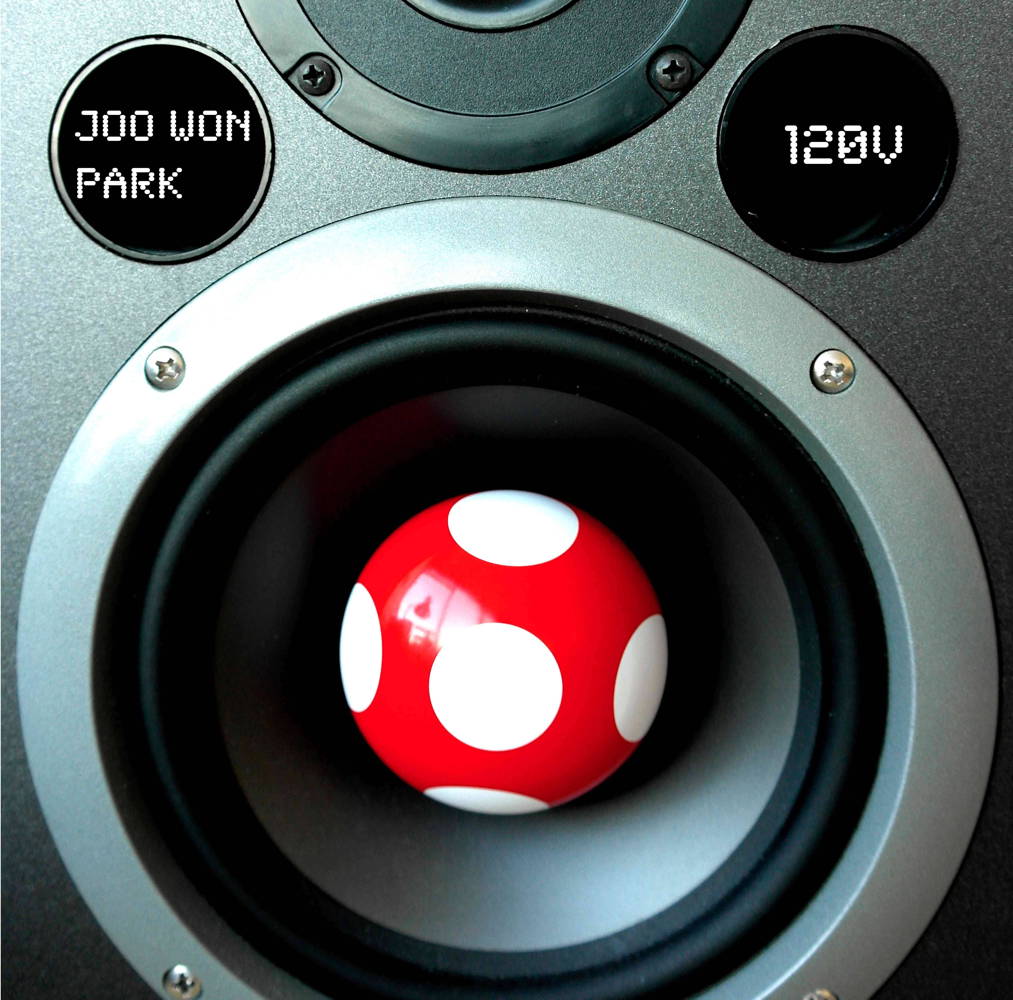
Track Listing:
I’ll be teaching a course in algorithmic composition in Fall 2014. To prepare for this course and other projects, I decided to reread books on the subject during the summer. The first book I am revisiting is Form+Code in Design, Art, and Architecture by Reas, McWilliams, and LUST.
I learned about the aesthetics of generative and code-based art from this book. I enjoyed applying the ideas and concepts I have learned to my music. The book taught me how to think about composition in numbers and codes.
I am thinking about requiring students to read at least the first chapter of the book. The summary of the chapter includes some great sentences:
“Learning to program and to engage the computer more directly with code opens the possibility of not only creating tools, but also systems, environments, and entirely new modes of expression. It is here that the computer ceases to be a tool and instead becomes a medium.” (p25)
The chapter also mentions that using a computer in art reduces the production time, so the artists can use the extra time and energy to explore the procedure and structure. Coding in art also enables a person to customize and “hack” the tool. These ideas are easily applied to computer music.
I also like the chapter because it gives succinct definitions on algorithm and code. Algorithm is a specific instruction to do a task (p13). Code is an algorithm written in a programming language (p15). Thus, an algorithmic composition is a process of making music with specific instructions written for computer.
Here’s a simple example of such algorithmic compositions. Introvert has algorithmically generated computer accompaniment for live melodica player. The computer part generates same chord progression, but the timing, volume, and octave position of each notes are chosen by the computer. This makes the computer part somewhat unpredictable, and makes the part unique for each performance.