Tag Archives: teaching

Academic Electronic Musician: An Example

Academic Electronic Musician: An Example is a collection of short articles on electronic music composition, performance, and presentation. The collection is useful for the following purposes:

  • Learn what a teaching electronic musician does (besides teaching)
  • Examine audio and scores for electronic music
  • Find examples of electronic music analysis and composition techniques
  • Get insights on electronic music practice in presentation, documentation, and education 

Download and study SuperCollider compositions and tools

The articles and examples in the collection are my research outputs. There is a value in reviewing and connecting works by an individual, different from the value gained from comparing and analyzing works by many. Alvin Lucier’s Music 109: Notes on Experimental Music and Gordon Mumma’s Cybersonic Arts: Adventures in American New Music, for example, gave me insight into an aspiring artist’s electronic music practice spanning decades. I hope this collection of writings serves the same purpose, but from the perspective of a lesser-known yet currently practicing full-time artist. 

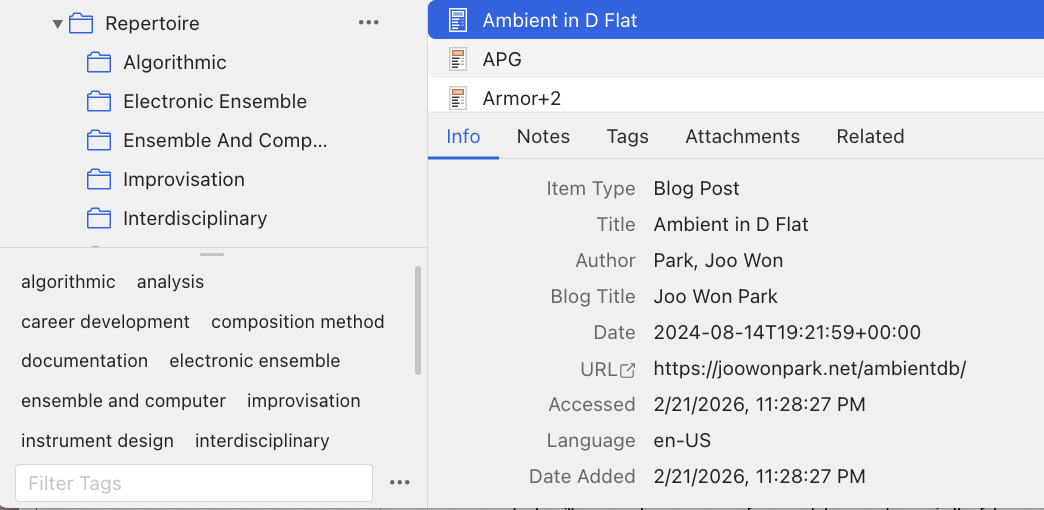
Academic Electronic Musician is hosted in Zotero, a multiplatform tool for organizing research data. The site allowed me to organize blog posts like a search engine tailored to my work. The site, pictured above, is most useful and effective when using tags and related links.  See the linked video for further explanation.


With its interactivity, Academic Electronic Musician may serve as supplementary material for electronic music classes and workshops. For example, if a class is learning about algorithmic composition, teachers can select the algorithmic and analysis tags to find examples with audio, code, and diagrams. Also note that the contents will grow as I compose, perform, and document more in the future. 

But on the site, you may not find typical information in other electronic music textbooks, such as

  • Tags linking to sources created by people other than me
  • Detailed Information about pieces written by other people
  • Instructions on using a specific audio app 

Numerous authors have written about these subjects with examples from well-known works. 

Electronic music researchers and practitioners find new theories and practices that could be useful to others. But those findings must be documented and shared. This, the sharing of knowledge, is what academic musicians do best. I hope the writings in the Academic Electronic Musician serve as an example for those who want to study and experiment with uniquely electronic sound in a musical context. 

Personal Statement – Explanation and Tips

Statement letter for tenure portfolio – music technology

My promotion and tenure portfolio included a personal statement. According to my department’s guidelines, a 3-5 page personal statement “addresses how their research, scholarly, or creative work has developed over time and what activities are likely to be undertaken in the future.” The document is sent to the external reviewers at the beginning of the evaluation process and is read by the department, college, and university committee. Like statement letters of any job application, the document is essential for both applicants and evaluators. 

Tenure-track faculty in music get various degrees of help and guidelines for the personal statement, but examples are rare in the public domain. Information on how to write or evaluate tenure-track faculty specialized in music technology is rarer. Therefore, I shared mine as an example for a tenure-track music technology faculty. I submitted my tenure packet in the Summer 2021 and was promoted to Associate Professor of Music in Spring 2022 at Wayne State University, an R1 public institution. A complete guideline for my WSU’s promotion and tenure packet is here.  

Tips

If you are writing a personal statement for a university tenure evaluation in the field of music technology, here are a few tips.

  • Seek an advisor in your institution. Learn the priorities and process specific to your job. There is a chance that you are the only, and the first, tenure-track music technology faculty. If so, find out what counts as acceptable activities and achievements for the review. (Does my solo performance of a no-input mixer and drum machine count as creative research?)
  • Know that the statement may be read and evaluated by both experts (external reviewers) and non-experts of your field (university-level committee). You need to convince people you do not know that you are good at what you are doing. (How do I convince my colleagues at Math that my no-input mixer and drum machine piece is research?)
  • Provide accessible and measurable evidence. Examples include a list of invited performances, documentation of refereed competitions, journals, conferences, and tracks released by record labels. Other people or institutions accepting your work can prove that your creative outputs are valued. (Multiple conference acceptance and guest artist invitations by other universities prove that my no-input mixer and drum machine are making an impact)
  • Do not be humble. Your department committee will need to convince the college-level committee how great you are. Your college-level committee needs to convince the university-level committee how awesome you are. Give them measurable achievements so that they can advocate for you. (Hey, Joo Won’s no-input mixer piece may not be pleasing, but look at the number of conference acceptance he received to play the piece)

The tenure process was not easy, but it gave me an opportunity to evaluate my career thoroughly. I look forward to writing a new version of the personal statement for the next promotion (which will be many years from now).

Updates – Aug 2014

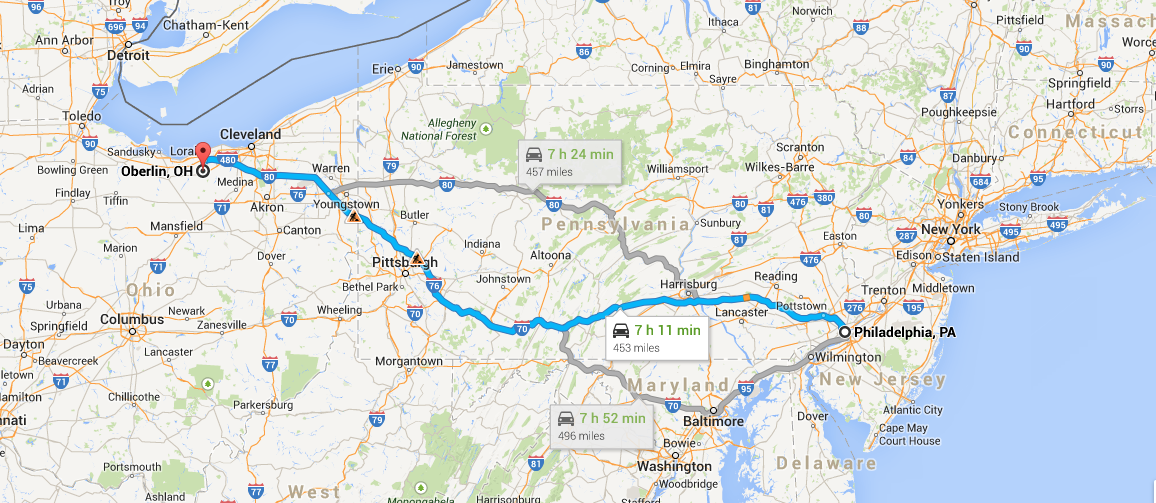
About a month ago, I have moved from Philadelphia, PA to Oberlin OH. I got a new job as a Visiting Assistant Professor of Technology in Music and Related Arts (aka TIMARA) at the Oberlin Conservatory of Music. I am extremely happy about this opportunity,  and am ready to meet great students and artists.

map

Oberlin is quite a different place than my former job at the Community College of Philadelphia. I worked at a metropolitan community college for six years, meeting a diverse group of students in a vocation-oriented curriculum. I strongly recommend CCP if you are in the Philadelphia area and wants to learn about recording and production. My current job, on the other hand, is in a private liberal arts college in a relatively small city, and I am expected to teach yet another group of diverse students who are studying in a music conservatory environment. They also seem to have  a different goal and aesthetics (compare the works of my CCP students and those of TIMARA).  It is thus inevitable that I need to create a different teaching plan.

Below is the link to my new syllabi for Fall 2014. I am teaching courses that I have not taught in my previous works, but my experience gained at Philadelphia is thoroughly integrated in the new syllabi. For example, two+ years of directing an electronic ensemble at the Community College of Philadelphia taught me how to plan a 16-week long improvisation ensemble class for any kinds of instrumentation. A SuperCollider class I taught at the Temple University became a basis for the Algorithmic Composition class that I’ll be teaching for an upper-level TIMARA students.

This year is going to be an exciting year for my life as a teacher. Like the past few years, encounters with brilliant minds and hearts will give me a chance to grow. I hope to do the same for my students.

Lastly, if you are around the NE Ohio area, please come to my first Oberlin concert on  9/10/14 at 8PM. The show is free and open to public.