Category Archives: Computer Music Practice

Teaching Materials For Electronic Music

Here are some electronic music examples you can listen to, play, and analyze for college-level music classes. They are introductory, free, and have specific purposes. Disclaimer: These materials are from my repertoire and projects, not references to DAWs or plugins. 

CML Suite – Arpeggios (2020)

Score: Download a PDF or go to page 9 of Google Slides Score

Description: Use the circle of fifths to play an electronic ensemble piece. The entire class can participate as long as each student has access to Chrome Music Lab

Recommended Use: 

  • Introductory exercise for electronic music ensemble classes
  • Interactive material for music theory classes when learning the circle of fifths
  • Audience participation piece for a concert


Dot Zip (2024)

Codes: Download a .zip file containing SuperCollider files

Description: 22 music examples and downloadable code for SuperCollider, a free audio coding app. There are no secret techniques. What you see in the code is what you are hearing.

Recommended Use:


Singaporean Crosswalk (2016)

Codes and Score: use the embedded link in the title

Description: Become a human surround sound system mimicking the nature and traffic signals in Singapore. SuperCollider must be installed on the performer’s computer (minimum of 4 performers), but previous experience in SuperCollider or electronic ensemble is not necessary.

Recommended Use:

  • Introductory repertoire for laptop ensemble: 20+ electronic ensembles have performed it in their concerts
  • Interactive material for music technology classes when learning surround sound and multichannel systems
  • Complementary example when learning about Alvin Lucier and classic electronic music repertoire.


Academic Electronic Musician (2026)

Project Page: Web link to Zotero Group Library. Works better on computers than mobile devices. Click on the Items icon in the subfolder when using mobile devices.

Description: A comprehensive example of an electronic musician’s creative practice. Use the tags and built-in search engines to research topics on composition, performance, and career development.

Recommended Use:


Is this useful and interesting? If so, please support by sharing, listening, and attending concerts.

I am also available for in-person workshops and virtual guest talks. Feel free to contact me via @joowonmusic
Option Escape (2026)

Option Escape for laptop ensemble uses the computer’s text-to-speech functions. In 2026, the speech read by a computer still sounds artificial and quirky. The ensemble of those artificial voices can become a musical entity. To perform Option Escape, each performer should prepare a text file consisting of sentences, words, numbers, and codes. The performer should also choose a favorite voice and ready the hotkey (option+esc in Mac OSX) to start and stop the speech.

Hardware Setup

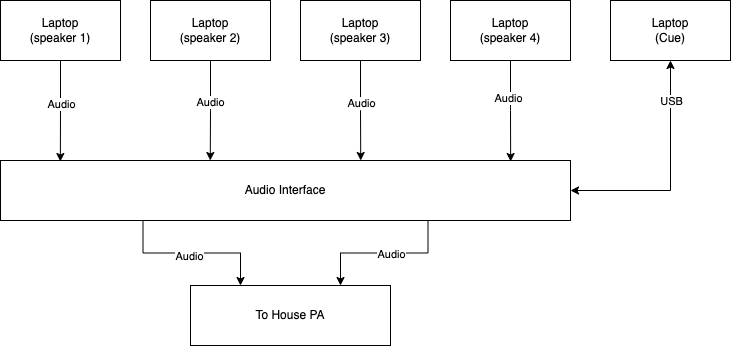
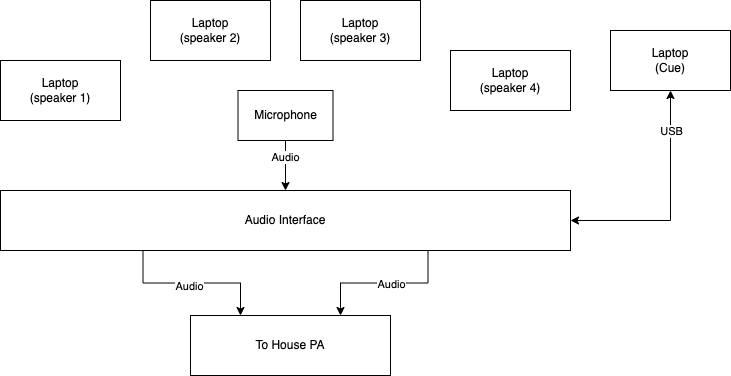
  • Minimum 5 computers with text-to-speech feature (Mac OSX preferred)
  • A multichannel audio interface OR an interface and a mic
  • Stereo PA system 
  • Audio cables to connect the laptops’ built-in outputs to the interface
  • Diagrams for two possible setups are shown below

Software Setup

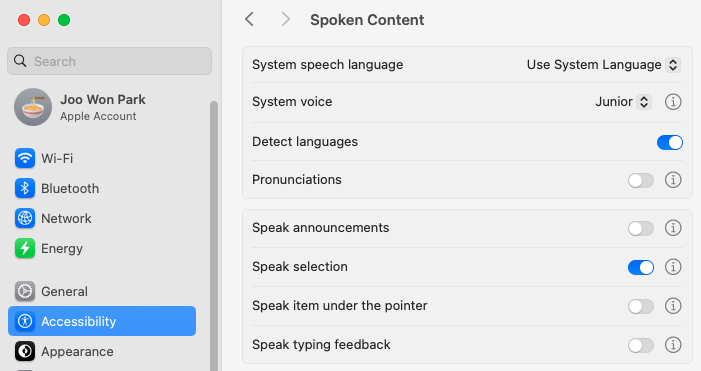
  • Performers, except for the Cue part, should change the computer settings to read the text with a computer-generated voice. In the current OSX, go to System Settings -> Accessibility. Enable Speak Selection. Change System Voice at will. See the above figure. 
  • Download SuperCollider files and score
  • The performer playing the Cue part runs optionesc.scd on SuperCollider.  

Score Interpretation

  • Speak 1/2/3/4 selects and text-to-speech the text in the prepared file according to the score. If the selected text ends before the next cue, repeat text-to-speech. 
    • Paragraph: Use two or more paragraphs.
    • Sentence: Use one sentence. 
    • 3 Words: Use three words.
    • Word: Use a word.
    • Vowel/ Number/ Symbol: Use a vowel, a number, or a symbol (test the symbols beforehand) 
    • Code: Use a computer code or a web address.
  • Speak 1/2/3/4 parts should prepare an original text file for a performance. Copy-paste the texts multiple times for a better performance. An example is included in the download (or click here).
  • The notehead indicates the text-to-speech reading speed. If the measure does not have a notehead, retain the previous reading speed.
    • Natural (no sharps or flats): read at normal speed
    • Flat (b): read at a slow speed
    • Double flat (bb): read at the slower speed
    • Sharp (#): read at a fast speed
    • Double sharp (x): read at the faster speed
  • In Cue 17, performers manually fade out the computer voice while speaking the paragraphs in their own voice. End at cue
  • One performer should operate the SuperCollider file as a cue player.
    • Open OptionEsc.scd
    • Select Menu -> Evaluate File
    • When the GUI appears, press the button according to the score
    • Cue the performers for the next section, if preferred
  • Performance Tips (for Mac OS 10.15 )
    • Place the left hand on the option and escape keys at all times. To quickly change the text, highlight the text, hold the Command key, and press the Escape key twice.
    • To read text faster or slower, double-click the rabbit or turtle quickly after the computer starts speaking.

Annecdote

The audio file below is a simulation I made while composing Option Escape. The listeners at the concert felt the low and high frequencies of the beats, but the mics in the concert hall could not capture the details of the SuperCollider part. If you are an ensemble director, please listen to the recording below for consideration of your next repertoire.

Academic Electronic Musician: An Example

Academic Electronic Musician: An Example is a collection of short articles on electronic music composition, performance, and presentation. The collection is useful for the following purposes:

  • Learn what a teaching electronic musician does (besides teaching)
  • Examine audio and scores for electronic music
  • Find examples of electronic music analysis and composition techniques
  • Get insights on electronic music practice in presentation, documentation, and education 

Download and study SuperCollider compositions and tools

The articles and examples in the collection are my research outputs. There is a value in reviewing and connecting works by an individual, different from the value gained from comparing and analyzing works by many. Alvin Lucier’s Music 109: Notes on Experimental Music and Gordon Mumma’s Cybersonic Arts: Adventures in American New Music, for example, gave me insight into an aspiring artist’s electronic music practice spanning decades. I hope this collection of writings serves the same purpose, but from the perspective of a lesser-known yet currently practicing full-time artist. 

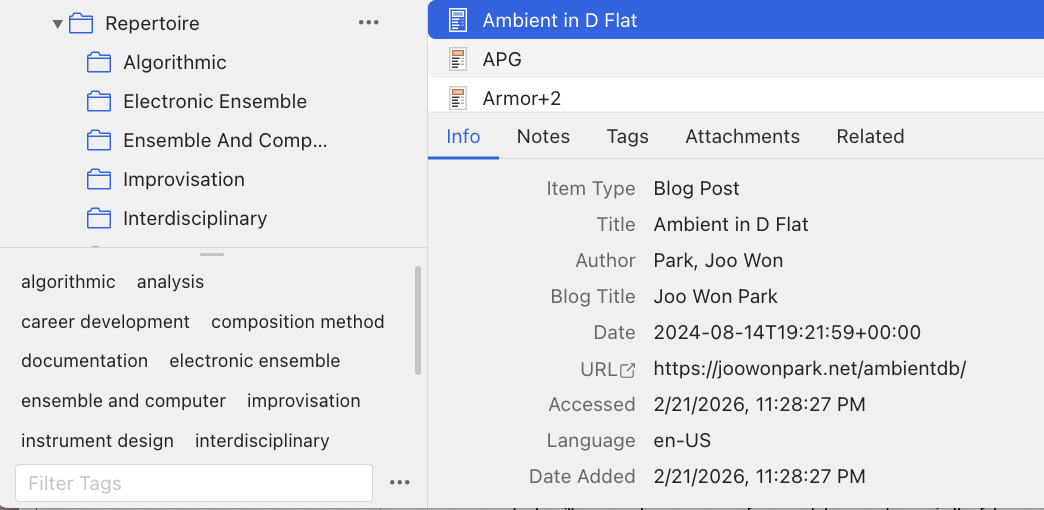
Academic Electronic Musician is hosted in Zotero, a multiplatform tool for organizing research data. The site allowed me to organize blog posts like a search engine tailored to my work. The site, pictured above, is most useful and effective when using tags and related links.  See the linked video for further explanation.


With its interactivity, Academic Electronic Musician may serve as supplementary material for electronic music classes and workshops. For example, if a class is learning about algorithmic composition, teachers can select the algorithmic and analysis tags to find examples with audio, code, and diagrams. Also note that the contents will grow as I compose, perform, and document more in the future. 

But on the site, you may not find typical information in other electronic music textbooks, such as

  • Tags linking to sources created by people other than me
  • Detailed Information about pieces written by other people
  • Instructions on using a specific audio app 

Numerous authors have written about these subjects with examples from well-known works. 

Electronic music researchers and practitioners find new theories and practices that could be useful to others. But those findings must be documented and shared. This, the sharing of knowledge, is what academic musicians do best. I hope the writings in the Academic Electronic Musician serve as an example for those who want to study and experiment with uniquely electronic sound in a musical context. 

Solo Electronic Improvisation

Since 2009, I have been presenting a solo set of live electronic music. Among the many electronic performance techniques, I specialize in creating electronic sounds on stage without pre-recorded samples. I use a combination of digital effect processors coded with SuperCollider to improvise a uniquely electronic soundscape in concerts and recordings. For more than a decade, I have marketed myself as an expert in that specific style. It is represented as a yellow rectangle in the diagram below. 

The categorization is not meaningful to anyone else, but it was a useful research goal for me in the 2010s. I share three representative pieces of my solo electronic improvisation for listening and analysis purposes.

Three Examples 

100 Strange Sounds (2012-2014) is a set of one hundred short video recordings featuring my live electronic music techniques. Each piece pairs a sound-making object with my SuperCollider code that processes its sound. I invite viewers to notice and enjoy the unexpected relationship between what they see and what they hear. For example, the sound of a cabbage becomes something else with a bunch of effect processors in 100 Strange Sounds #77

Large Intestine (2013) is a piece I made after 100 Strange Sounds #42. As described in the blog on style analysis, the no-input mixer improvisation enhanced with SuperCollider has been my favorite electronic instrument for more than a decade. Large Intestine, as the title suggests, epitomizes my interest in noise, digital signal processing, and improvisation. I plan to play this work in as many concerts as possible in the future.

Touch (2014) is my kitchen-sink piece that pairs multiple sound objects with multiple effects. It’s a summary of 100 Strange Sounds, in which I bring random objects on stage and improvise the combination and sequence of sounds. The piece opened many doors to career opportunities in the 2010s as an electronic music improviser. The techniques and technologies I learned in performing and refining Touch became a source for future non-improvisational compositions for electronic ensembles. 

Technology

All three pieces mentioned above use a variation of a single SuperCollider patch, available for download at this link. And this linked PDF explains the hardware and software setup to perform the pieces (warning: it is a little outdated). 

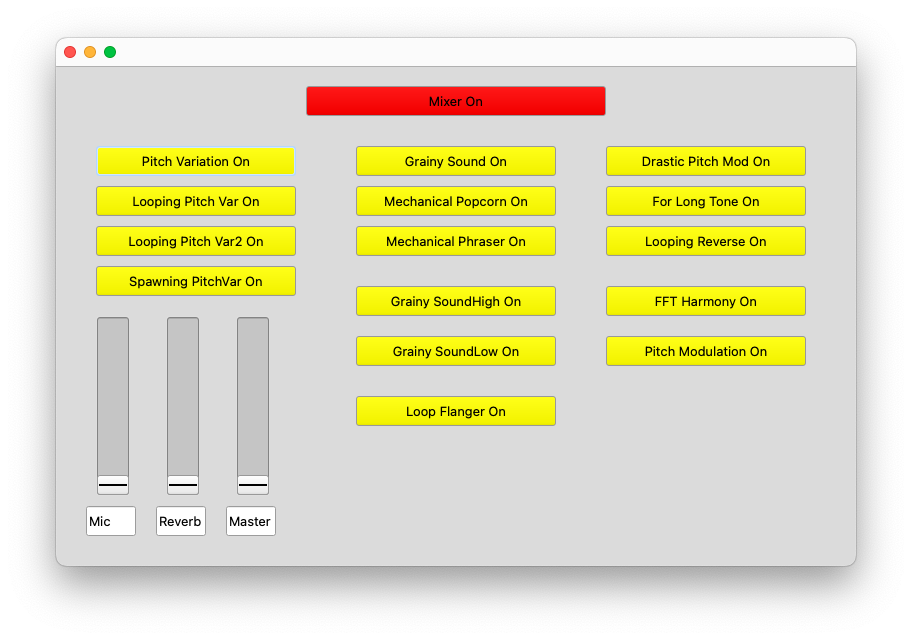
When I run the patch, it creates a GUI with multiple buttons that trigger customized effects. I control the number and timing of the effects’ on/off states with a mouse click – No MIDI controllers or control surfaces. A few clicks, probably unnoticed by the audience, are enough because I wanted the listeners to focus on the interaction I have with the non-electronic objects on the stage. 

As for the hardware,  I use a couple of microphones for Touch, one audio interface, and a laptop. This article explains the gear I used over the past 11 years.

Technique

Like other improvisations, the key technique in performing solo live electronic music is listening. I listen for variations that the computer part adds to the acoustic instruments, then respond with another instrument or effects. Because I cannot play a scale or harmony with the instrument (like cabbage), the listen-and-react decisions are often non-musical and raw. “The current sound is long, so I’ll play short sounds next.” “I will go from a simple to a complex texture.”  “The sound is very high in pitch. I’ll complement it with a very low rumble.” I also ask questions and try to come up with the best answer on stage. “What happens if I granularize the chattering teeth sound?” “The plastic block sounds harsh. Can I make it harsher?” “What is common between a slinky and a coin sound?”  

Free improvisation focusing on reactions and questions is fun, but it can quickly lose control of the length and form. So I plan a specific gesture or sound combination for transitions. The Extension and Connection blog linked earlier has such an example in Touch.  

Annecdote

More than fifteen years of experience in improvising with live electronics forms the foundation of my musicianship. I identified myself as a composer after earning a PhD in composition in 2008, but it did not lead to a gig or collaborations when I moved to Philadelphia for my first job as a music technology professor. The dire situation led me to develop a solo set I can prepare and present quickly in any situation. The strategic change, fortunately, worked, giving me ample opportunity to refine my performance and improvisation techniques. 

These days, I am comfortable identifying myself as a composer-performer of electronic music. My sound may not be fresh or cutting-edge at this point, but I think I have a bit more to contribute to the current solo setup. Perhaps the contribution is a documentation and theorization. Perhaps it is just one more new piece!

More electronic music composition/performance/practice articles are found at the Computer Music Practice project.

Extension and Connection – Computer Music Composition Method

Music technology extends an instrument’s acoustic capacity. An amplifier makes a guitar louder than an orchestra. A pitch shifter expands the range of a snare. Singing through a delay or harmonizer creates thick harmony that one cannot make as a soloist. Computer music compositions, then, feature digital tools that overcome the physical limitations of acoustic instruments. It also uses electronic sound to connect one section to the next, or one story to another.  

Sonic metaphors with digitally processed sounds, which I call extension and connection, are observable in electroacoustic compositions. My favorite example is at around the 2:00 time mark in Paul Riker’s Cubicle (2007). In there, typing sounds multiply to become a rain. It signals the beginning and the ending of a section. The telephone and dog barking sounds in the piece also go through uniquely electronic transformations and serve as a signal to a section or scene change. Listen to the whole piece to see if you agree with my interpretation.

Another favorite example is in Paul Koonce’s Breath and the Machine (1999). In the first three minutes of the piece, some overtones of a two-note violin motif linger longer than the rest. Those extended and exposed overtones of the violins train the listener’s ears to focus on them so that they can notice the same technique throughout the piece. Once the ears are tuned to search for the extended overtones, sections with seemingly random choices of different sounds make sense – the series of lingering overtones, for me, form a melodic line. I listen for counterpoint and common tone modulation between sounds that are difficult to notate traditionally. Again, listen to the whole piece to see if you agree. 

Paul Koonce was my doctoral advisor, and I have known Paul Riker as an inspiring colleague. I learned electroacoustic extension and connection from exemplary teachers and colleagues during my graduate school years, and have refined it since then.  My take on the typing-to-rain sound is in the first and last movements of Dubious Toppings (2019). At the 1:00 time mark, the electronic ensemble collectively creates rain-like typing sounds, stating the potential and limit of the featured digital instrument and its relationship to a piano. This opening gesture repeats at the last movement at the 8:30 time mark, but with pitched tones. I wanted to end the piece like a movie’s final scene, where a changed protagonist returns home after an adventure.

I learned to thread different sounds with common effects from Breath and the Machine, and apply them in electronic improvisation. In the linked 2015 video, many sound-making objects are processed with a SuperCollider patch with a fixed set of effects. The common effects bound seemingly random objects. A chattering teeth toy and a spinning coin could connect if both go through the Looping Pitch Var effect on my patch.

As for creating a form, I reserve a specific combination of effects and objects for transitions. At around the 11:50 time mark, I use a slinky combined with a granular processor and long reverb to signal a new section. Planning a soundmark like this helps me to develop and pace. The videos of other improvisations from 2015 and 2017 show the same slinky technique occurring in the latter half of the performance.   

The extension and connection demonstrated in this article are within a specific composition. But the concept can be applied on a larger scale. Sampling and remixing are about connecting and extending sounds from existing songs. Audio coding can start by extending existing code and connecting it to another module to create a product.  On a personal level, I extend and connect what I learn from my peers and teachers by applying it in different contexts, formats, and technologies. Below is the current practice of my extend and connect project.

Computer Music Practice