Tag Archives: electroacoustic

On Off Fade – Etudes for Electronic Music Ensemble No. 2

Link to Score

An electronic instrument can express a gradual or sudden change of timbre by twisting a knob or a slider. On Off Fade for an electronic ensemble is written to practice deliberately timed change in dynamics, density, and spectrum. The ensemble may consist of a percussion and three or more electronic devices. Specific models of electronic devices or previous experiences in an electronic ensemble are not required to perform this piece.


Instrumentation

Three or more electronic Instruments:

  • A machine that produces noise-like sound is preferred.
  • The performer should be able to control at least the volume and another parameter of the sound continuously. More the controllable parameters, better the instrument.
  • Examples of such devices include a radio, drum machine, no-input mixer, turntable, modular synthesizer, electronic metronome, circuit-bent toys,  and analog television.

One drumset OR drum machine:

  • A drumset consisting of a bass drum and a snare is ideal. Alternatively, one may use a drum machine that can trigger bass drum, snare, and rimshot sounds.
  • A drum machine should also be able to start and stop a preset rhythm.

Performance and Score Instruction
For an ideal balance of sound, adjust the volume of the instruments so that they do not overpower the drumset or the drum machine.
Notation for Electronics:

  • Regular notes and rests: start and stop the sound by increasing and decreasing the volume control. All notes should have a short attack and release time unless notated with crescendo or decrescendo. Respect the duration of the rests.
  • Notes with the + sign: change a parameter. For example, a synthesizer player can turn a filter knob. If there is more than one parameter control, feel free to change multiple parameters.
  • Crescendo and decrescendo: For regular notes, gradually change the volume control (a dynamic marking of n being no sound to ff being the loudest sound possible). For the + notes,  change a parameter.

Notation for Drumset or Drum machine:

  • At the absence of a conductor, the drummer cues the next section.
  • If a snare roll is not possible, trigger a preset rhythm in place of a snare roll.
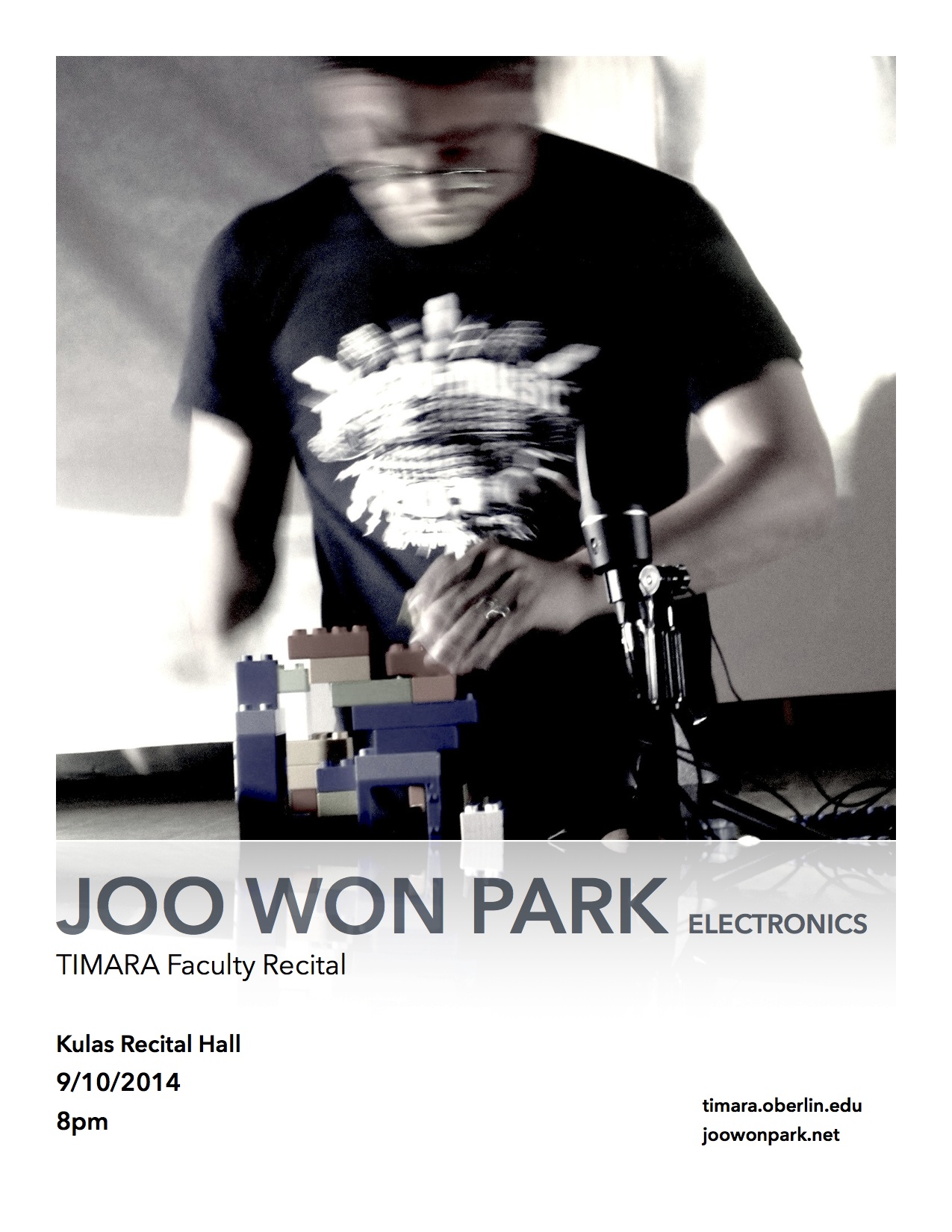
Joo Won’s First Recital in Ohio

FacultyRecital


If you are in NE Ohio area,  come to my debut concert at the Oberlin Conservatory. Performance is my best way to say hello to the community.  The concert is free and open to public. I do not know many people around here yet, so please share this information to your Ohio friends who are into experimental/noise/electroacoustic sounds. Or invite your worst enemy.

Work in Progress : The Hunchback of Notre Dame

I’m in charge of the sound and music for The Renegade Company’s upcoming theatre production. The company will reinterpret The Hunchback of Notre Dame in a silent movie style. There will be no dialogues in this nightmarish and grotesque version, and my electronic sounds will fill the space instead.

The director of the company proposed me to make a painful sound to reflect the main character’s suffering.  The play is set in Quasimodo’s dream, and therefore the sound should also convey Quasimodo’s severe hearing damage as well as his emotional state. I imagine that many years of playing the church bell may have caused Quasimodo tinnitus or ringing in the ear.

The most challenging part of this project is that I will not be able to attend some of the shows as I will be 7+ hours away from the theater (a beautiful church in Center City Philadelphia). Despite this geographic challenge, I do not want to make a fixed audio file for this project.  Instead, I want to make an easy-to-operate  software that make unique sounds for each show.  I also decided to focus on the emotional aspect of the characters.

HunchBackProto

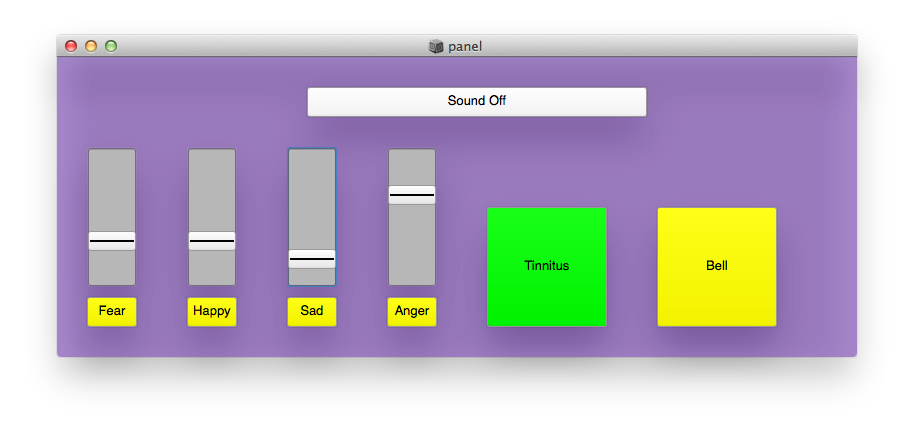
The instrument I am building has four emotion sliders: fear, happy, sad, and anger. Each emotion currently has 3-4 different sounds that are controlled by corresponding slider. Also, there are buttons to turn on a sound that simulates tinnitus  and trigger bell sounds.

Below is an example sound of what my current system can do. I improvised for about 6 minutes by combining different emotions as well as triggering tinnitus and bell sounds.

For the actual show, I expect that the sound guy will do the following  tasks:

  1. Press emotion buttons whenever there is a scene or character change. The button will randomly trigger a sound. For example, Quasimodo’s happy sound could be different from Esmeralda’s happy sound.
  2. Increase the slider as the character’s emotion intensifies. For examples, if Quasimodo is little sad, put the slider to 30%. If Quasimodo is extremely sad, crank up the slider to 100%. The change in slider movement will change the “intensity” of the sound. There are many different interpretations of intensity in this software.
  3. Click Tinnitus button. The sound is very long and emotionally draining
  4. Click Bell button according to the play’s cue. The bell sound has an algorithm to play different resonances every each time.

There are many benefits of composing a software instead of recording tracks.

  1. The sound can response more flexibly to the character’s action, especially at improvised sections.
  2. The music sound different every time it is played. They will sound familiar, but the details will be different (think about a jazz pianist interpreting a standard. The pianist would play the same chord progression, but the actual resulting sounds are different every time).
  3. The software is easy enough to be operated by anyone. I shouldn’t have to be there to create sounds.

I’ll be meeting with the director in few days to show my progress. If the director likes the idea, I continue to work on it. I’m also waiting for the response of a percussionist. If he is available, there will be a live percussion accompaniment on top of the electronic part. If he’s unavailable, the sound needs to be a little more exciting.

Please feel free to let me know your thoughts on the sound and performance approach. Does it resemble the sound world of Quasimodo’s nightmare? Do you foresee any technical troubles?