Category Archives: Compositions

A DREAM IS A HOUSE for remembering the future


A DREAM IS A HOUSE for remembering the future from Biba bell on Vimeo.

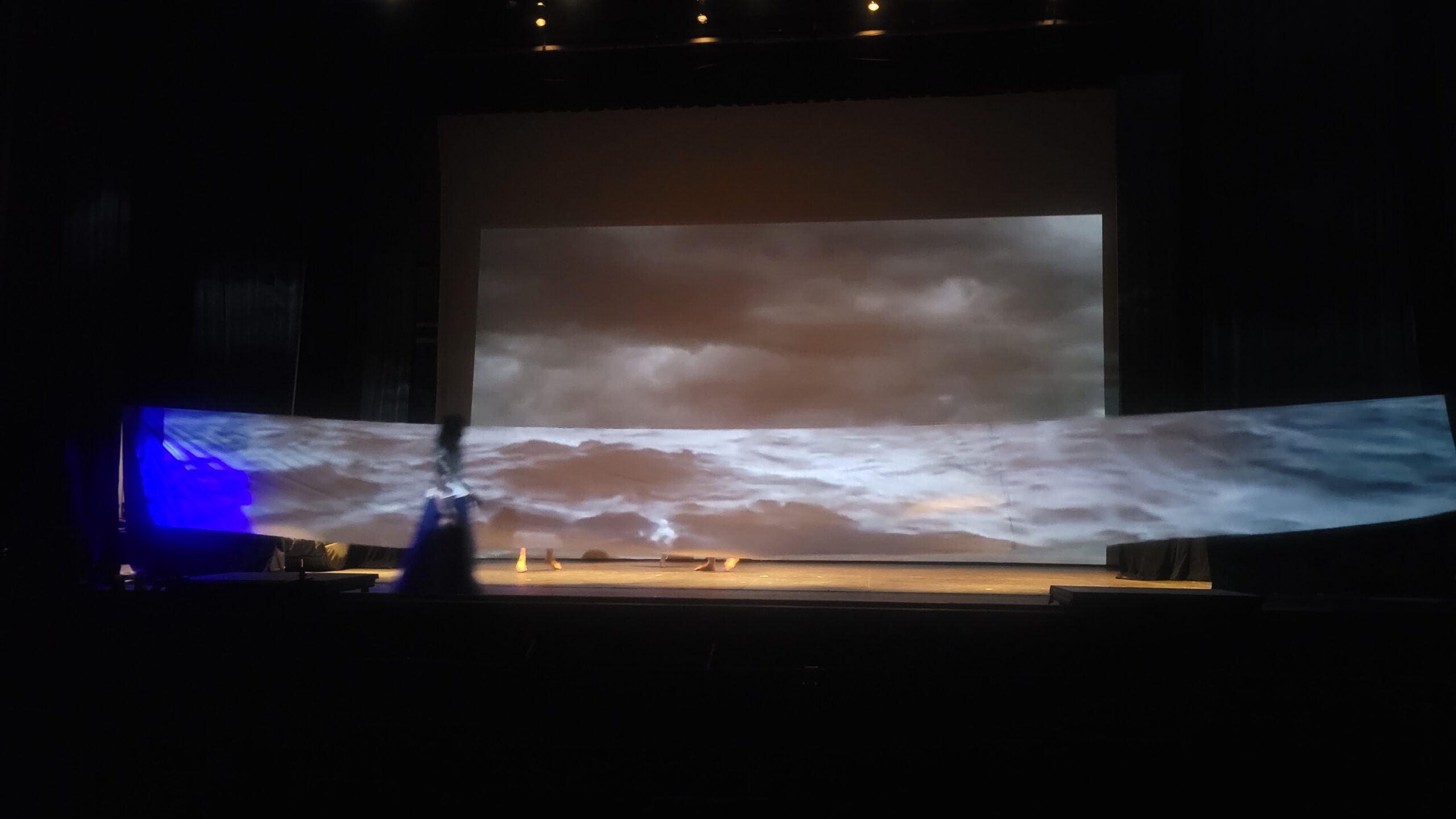
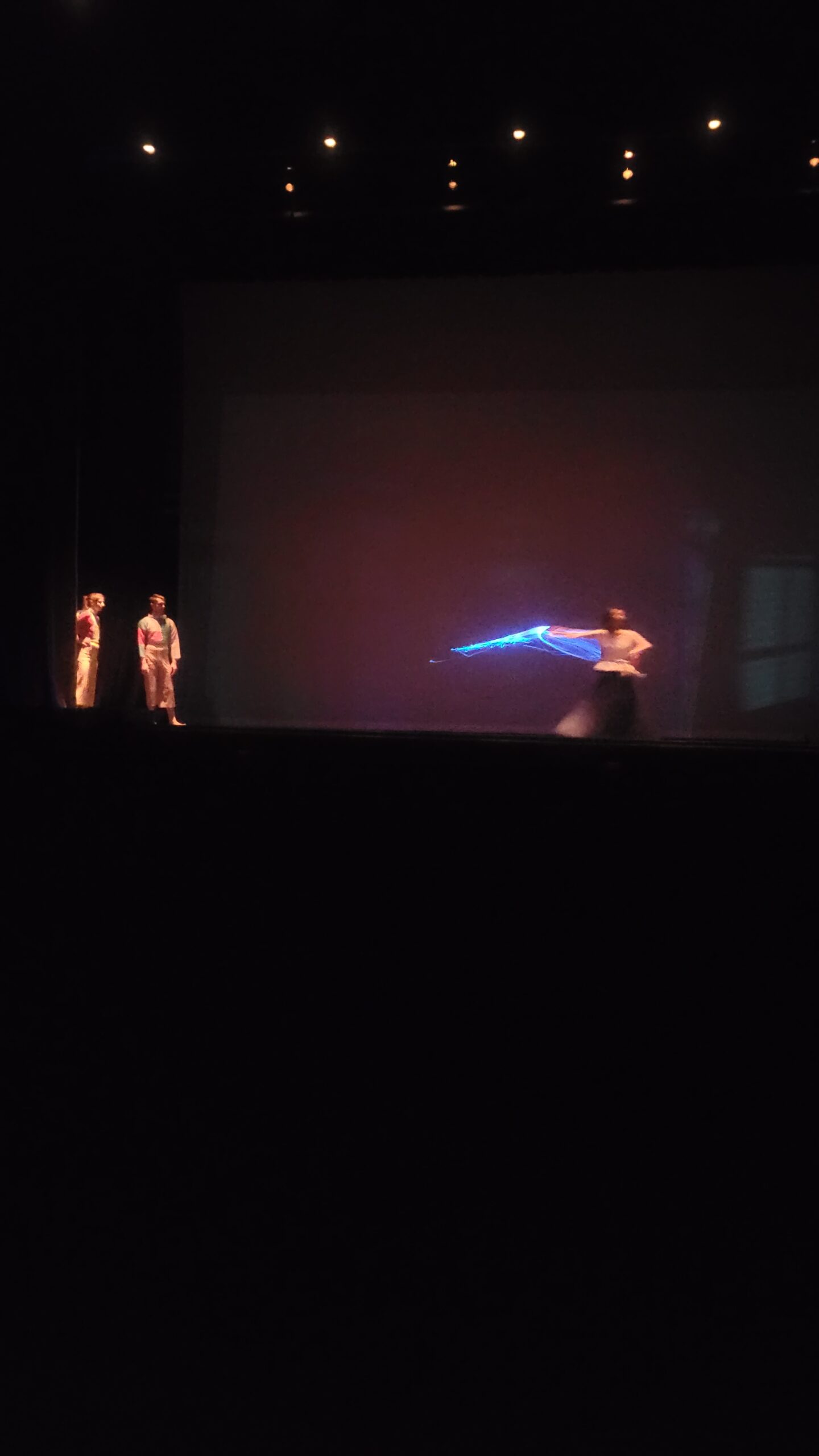
A DREAM IS A HOUSE for remembering the future, created in collaboration by Biba Bell (Dance) and Joo Won Park (Music), is an hour-long immersive performance created for twenty-one Wayne State University (WSU) dancers and the WSU Electronic Music Ensemble in Minoru Yamasaki’s McGregor Conference Center atrium. A DREAM IS A HOUSE brings together sound, light, movement, embodiment, and storytelling together in the cathedral-esque modernism of Yamasaki’s architecture, evoking creative research driven by memory palaces, buildings as bodies, dream scenes, dancing with ghosts, and personal and collective ritual making. – from Vimeo site

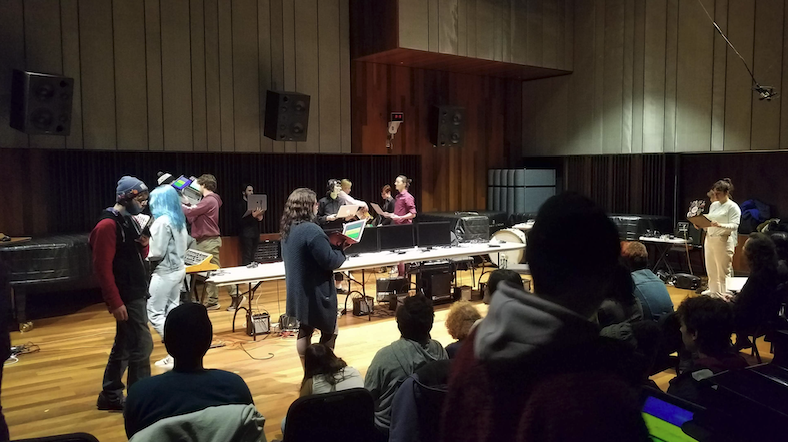
My ensemble (EMEWS) and I worked with Biba and her Dance Class to make a site-specific, multi-channel piece over the Winter 2022 semester. The above is an excerpt of a 60-min piece. McGregor Hall’s architecture and acoustics were ideal for music and movement. I am happy about the result. The in-person experience was something unique, but Noah Eliott Morrison‘s team documented the essential experience of the piece in the video. 

Although EMEWS has worked on the piece since March, I started working on it in August 2021. Biba and I spent Fall 2021 trying ideas and finding voices. The video below is a shorter version of A DREAM…  presented at an end-of-semester showcase.

A dream is a house for remembering the future 12.07.21 from Biba bell on Vimeo.

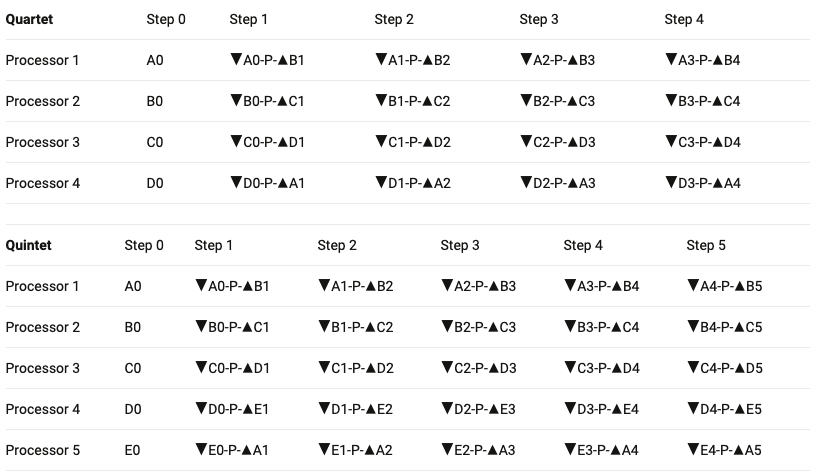
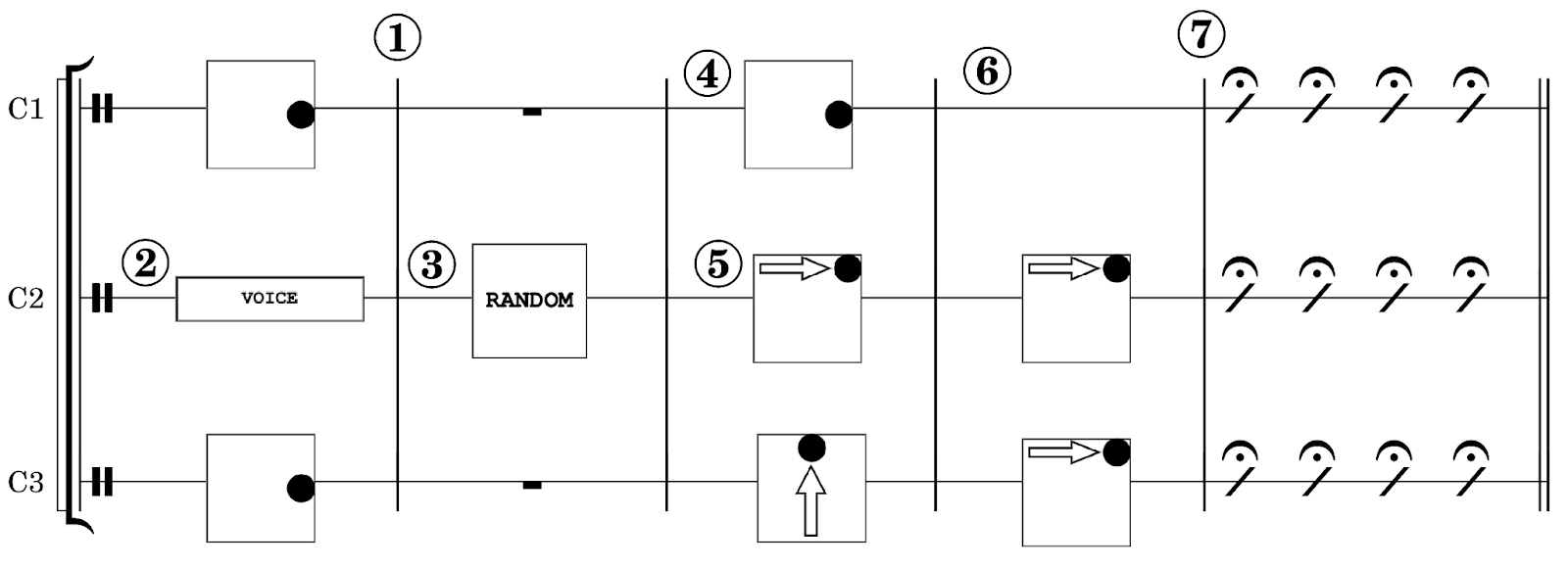
The Fall version’s 15min stereo audio expanded to a 60-min piece for a laptop ensemble and a guitarist, each emitting sounds from a portable amp. The music evolved and adjusted every week as the choreography changed, and the ensemble ended up performing based on the score below.
I think music can have an altered life. I plan to perform an audio-only ensemble version in an upcoming show. Let’s see how it goes. 


Notes and Comments : Remix EP

I write notes and comments in books, journals, and PDFs. Underlines and scribbles of my thoughts do not change the work, but they help me remember what I liked most about the work and the artist. The four tracks in this album are the sonic equivalent of notes and comments. I highlighted the most memorable characteristics while trying my best to preserve the intent of the original piece. The last track is not a remix, but it is my way to document a few good things about the summer of 2020.

The original tracks are

Alex Koi, Last Goodbye (2020)
alexkoi.bandcamp.com/track/last-goodbye

Michael Malis, Imperfect Intervals IX – Gently, Freely (2021)
michaelmalis.bandcamp.com/track/imperfect-intervals-ix-gently-freely

Molly Jones, Solar Wind (2020)
mollyjones.bandcamp.com/track/solar-wind

Jienan Yuan, Invisible Embrace (2021)
youtu.be/7sU4ilzXnmg

* All tracks were used with the permission of the composers/publishers. Profits made from the sale will be distributed to the remixed artists.
* Overall mix of the EP is relatively low and uncompressed for quiet listening.

credits

released February 2, 2022

Molly Jones, Alex Koi, Michael Malis, & Jienan Yuan, composers
Joo Won Park, composer & remixer

Electronic Ensemble Repertoire

Here are my compositions for electronic ensemble since 2016. They are categorized by the gears needed.

Laptops

Singaporean Crosswalk (2016)

Dubious Toppings (2019)

Sum and Difference (2021) *for remote rehearsal and performance

Four Hit Combo (2024)

Save Point By The Lake (2024)

Option Escape (2026)

  • Info and Score
  • Need 5 or more laptops
  • One performer needs SuperCollider, a microphone, and an audio interface

Laptops or Phones

Beat Matching (2018)

CML Suite (2020)

  • Info and score
  • Need: 3 or more computer, tablet, or phone. Amplification strongly recommended

Laptops and Acoustic Instruments

Nested Duets (2022)

Laptops With Controllers

PS Quartet No.1 (2017)

PS Quartet No. 2 (2019)

Electronic Instruments

On Off Fade (2019)

Seven Bird Watchers (2019)

Works 2019-2009

Works 2019-2009

I am sharing eleven old pieces in reverse chronological order. I don’t consider them as my best of’s, but they are more like excuses to “what happened?” and “why did I do that?” Excuses are rarely correct answers to the questions, but they are somewhat related and much more entertaining. I invite you to listen to my incoherent explanation of why I play drum machine solo instead of recording soothing summer rain sound.

Link to album

https://1473.bandcamp.com/album/works-2019-2009

From the label director, Chien-An Yuan:

Curated by Joo Won @joowonmusic himself, “Works 2019-2009” is an outstanding showcase of his development as a sound artist, in reverse. Joo Won’s music sits precisely at the intersection of sound, technology, and innovation – communicated both in his compositional processes and choice of hardware. There is no passive engagement with his music – by choice or chance, Joo Won’s music demands active listening – there are so many disparate elements to focus on, so many new sounds, that it’s always a thrill to listen to one of his pieces.

Having “Works 2019-2009” as the 20th 1473 release is perfect, really – by providing an overview of an artist’s journey, it serves as the perfect way to mark this milestone for the label. Starting with release 21, the look and mission of 1473 will shift and open up even more – I’m incredibly excited and I hope you are too!

Quite importantly, and as addressed in previous posts, today is Bandcamp Friday when Bandcamp ensures that 100% of income is passed directly to artists and labels by waiving their transaction fees. Joo Won and I are happily passing this income towards raising funds for Spread Art in Detroit, a vital independent art space, run by the formidable Shiva @shivoid

Please help support Spread Art’s mission by purchasing Joo Won’s album today. I promise you’ll be excited by all of the new sounds you hear.

https://www.instagram.com/p/CK6LVKblNHp/

Sum and Difference (2021)

Link to Score (Google Doc)

Sum and Difference is a collaborative composition guideline for music technologists. Each member of the ensemble joins in an online meeting platform to process audio files according to the score. The result is new sample-based compositions that share similar characteristics. The pieces are also different due to the variety of the original samples and the ensemble member’s improvised parameter changes.
For participants, Sum and Difference is more about the process of making it than the result. In the pandemic-influenced time, the joy of creating music together, the joy of creating something from nothing in an ensemble, is severely limited. But the current situation forces music technologists to experiment with collaborative methods best suited for online interaction. Sum and Difference works best when each member is on the Internet, physically alienated from the rest of the world.

by Joo Won Park

Performers 

Number of performers: 4-10  

Needed technology

  • A web folder accessible by all performers
  • An audio editor or DAW for each performer

Needed skills

  • Experience and knowledge in digital audio editing and processing
  • Data organization and management skills

Preparation

  1. Make a sharable web folder
  2. Upload recordings of non-musical sound with the file names shown in the score (A0.wav, B0.wav, etc.) 
    • The number of uploaded audio files should equal the number of performers
    • Each audio file should be 2-5 seconds long 
    • Each audio file should be distinct from the others 
  3. Each performer should plan a processing or editing technique to change an audio file
    • Use any DAWs or apps
    • Establish a short and repeatable process. The performer should be able to execute it within 5-10 minutes

Execution

Step 0. Gather using a remote meeting platform such as Zoom or Google Meet. Assign one performer to one Processor. 

Step 1. Download, process, and upload the audio file from the web folder according to the score. 

Each cell in the score has ▼FileName-P-▲FileName.  Here’s an example of how to interpret it

If the cell has ▼A0-P-▲B1

  1. Download file named A0.wav from the web folder
  2. Process the sound according to the plan
  3. Export the sound with file name B1.wav, and upload it to the web folder

Step 2-10. After 10 minutes, repeat the download-process-upload procedure described in Step 1

  1. Vary the processing parameters (i.e., move knobs, use different settings)
  2. Strive to add a few more seconds of sounds
  3. Edit and polish the sound if possible (i.e., delete the silence at the beginning, normalize, etc.)
  4. Be consistent with the file format. Use a format readable by all platforms, such as .wav and .aif

Last Step. Share and listen to the resulting sounds. The number of final tracks should equal the number of performers.

Score by Ensemble Size 

Link to Google Sheet Template 

QuartetStep 0Step 1Step 2Step 3Step 4
Processor 1A0▼A0-P-▲B1▼A1-P-▲B2▼A2-P-▲B3▼A3-P-▲B4
Processor 2B0▼B0-P-▲C1▼B1-P-▲C2▼B2-P-▲C3▼B3-P-▲C4
Processor 3C0▼C0-P-▲D1▼C1-P-▲D2▼C2-P-▲D3▼C3-P-▲D4
Processor 4D0▼D0-P-▲A1▼D1-P-▲A2▼D2-P-▲A3▼D3-P-▲A4
QuintetStep 0Step 1Step 2Step 3Step 4Step 5
Processor 1A0▼A0-P-▲B1▼A1-P-▲B2▼A2-P-▲B3▼A3-P-▲B4▼A4-P-▲B5
Processor 2B0▼B0-P-▲C1▼B1-P-▲C2▼B2-P-▲C3▼B3-P-▲C4▼B4-P-▲C5
Processor 3C0▼C0-P-▲D1▼C1-P-▲D2▼C2-P-▲D3▼C3-P-▲D4▼C4-P-▲D5
Processor 4D0▼D0-P-▲E1▼D1-P-▲E2▼D2-P-▲E3▼D3-P-▲E4▼D4-P-▲E5
Processor 5E0▼E0-P-▲A1▼E1-P-▲A2▼E2-P-▲A3▼E3-P-▲A4▼E4-P-▲A5

Score for larger ensembles are available in the Google Doc Version

Demo/Example

Link to all files made in a 10-piece ensemble version

Made  by Electronic Music Ensemble of Wayne State (EMEWS) on Jan 20, 2021

Matthew Banka, Maxwel Bourgeois, Garrison Briggs, Daniel Kozlowski, Logan Macka, Benjamin Schornack, Alec Segel, Mark Whalen, Daniel Yates, Michael Younger

Compare and listen to the process

J0, A1, B2, C3, D4, E5, F6, G7, H8, I9, J10 (one sample going through ten processes)