
Music technology extends an instrument’s acoustic capacity. An amplifier makes a guitar louder than an orchestra. A pitch shifter expands the range of a snare. Singing through a delay or harmonizer creates thick harmony that one cannot make as a soloist. Computer music compositions, then, feature digital tools that overcome the physical limitations of acoustic instruments. It also uses electronic sound to connect one section to the next, or one story to another.
Sonic metaphors with digitally processed sounds, which I call extension and connection, are observable in electroacoustic compositions. My favorite example is at around the 2:00 time mark in Paul Riker’s Cubicle (2007). In there, typing sounds multiply to become a rain. It signals the beginning and the ending of a section. The telephone and dog barking sounds in the piece also go through uniquely electronic transformations and serve as a signal to a section or scene change. Listen to the whole piece to see if you agree with my interpretation.
Another favorite example is in Paul Koonce’s Breath and the Machine (1999). In the first three minutes of the piece, some overtones of a two-note violin motif linger longer than the rest. Those extended and exposed overtones of the violins train the listener’s ears to focus on them so that they can notice the same technique throughout the piece. Once the ears are tuned to search for the extended overtones, sections with seemingly random choices of different sounds make sense – the series of lingering overtones, for me, form a melodic line. I listen for counterpoint and common tone modulation between sounds that are difficult to notate traditionally. Again, listen to the whole piece to see if you agree.
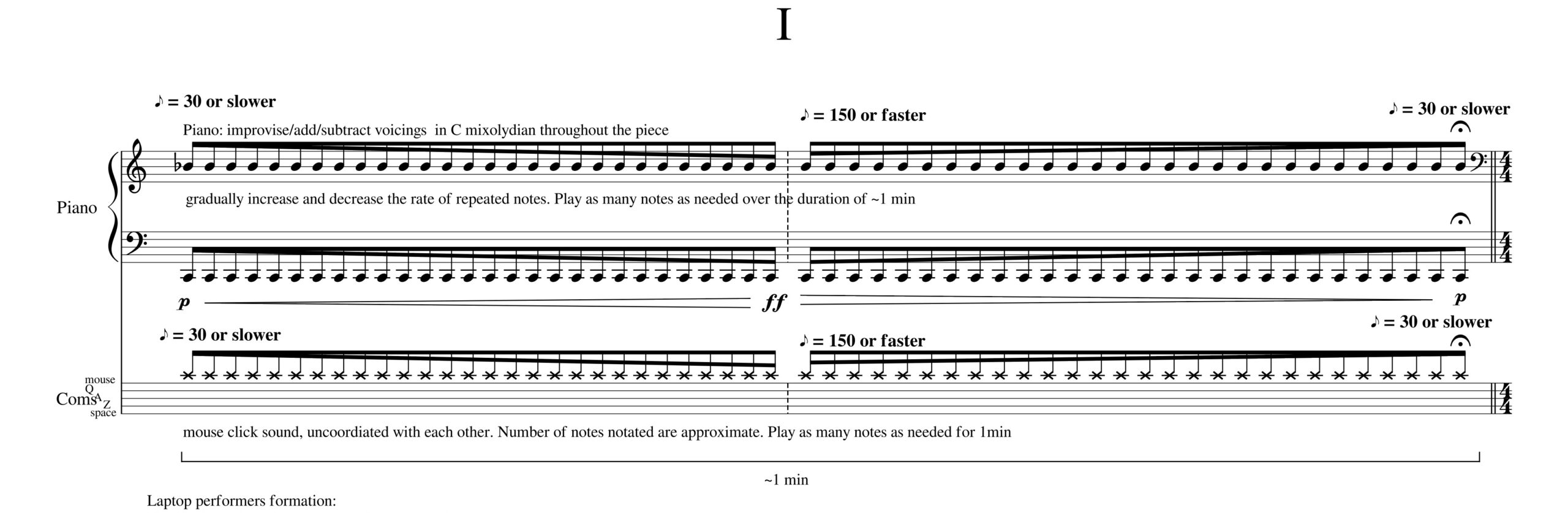
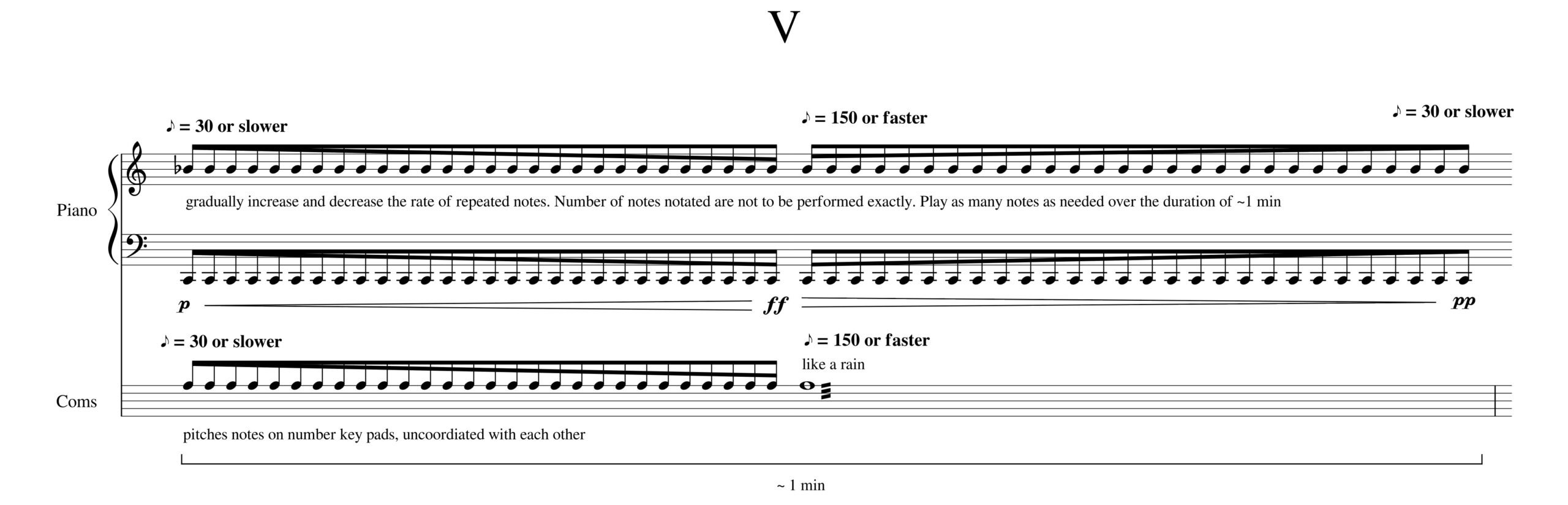
Paul Koonce was my doctoral advisor, and I have known Paul Riker as an inspiring colleague. I learned electroacoustic extension and connection from exemplary teachers and colleagues during my graduate school years, and have refined it since then. My take on the typing-to-rain sound is in the first and last movements of Dubious Toppings (2019). At the 1:00 time mark, the electronic ensemble collectively creates rain-like typing sounds, stating the potential and limit of the featured digital instrument and its relationship to a piano. This opening gesture repeats at the last movement at the 8:30 time mark, but with pitched tones. I wanted to end the piece like a movie’s final scene, where a changed protagonist returns home after an adventure.
I learned to thread different sounds with common effects from Breath and the Machine, and apply them in electronic improvisation. In the linked 2015 video, many sound-making objects are processed with a SuperCollider patch with a fixed set of effects. The common effects bound seemingly random objects. A chattering teeth toy and a spinning coin could connect if both go through the Looping Pitch Var effect on my patch.
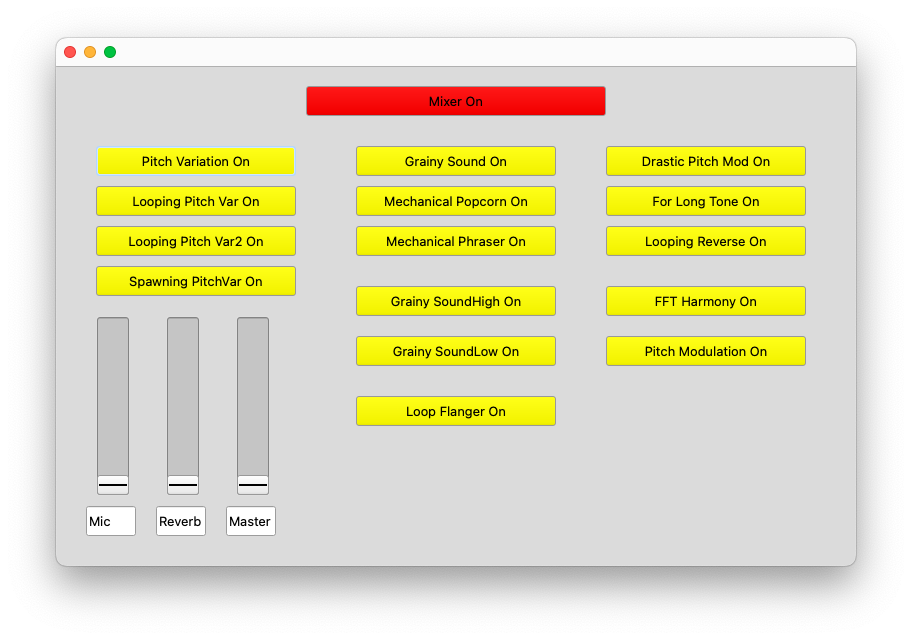
As for creating a form, I reserve a specific combination of effects and objects for transitions. At around the 11:50 time mark, I use a slinky combined with a granular processor and long reverb to signal a new section. Planning a soundmark like this helps me to develop and pace. The videos of other improvisations from 2015 and 2017 show the same slinky technique occurring in the latter half of the performance.
The extension and connection demonstrated in this article are within a specific composition. But the concept can be applied on a larger scale. Sampling and remixing are about connecting and extending sounds from existing songs. Audio coding can start by extending existing code and connecting it to another module to create a product. On a personal level, I extend and connect what I learn from my peers and teachers by applying it in different contexts, formats, and technologies. Below is the current practice of my extend and connect project.